DIGITAL LEADERSHIP— BECOMING THE NEW NORMAL!

GAGAN

DIGITAL LEADERSHIP— BECOMING THE NEW NORMAL!


DIGITAL LEADERSHIP
Digital leadership


We have all head this mantra multiple times and in multiple ways. The world is changing—fast. Technology is driving change—even faster. People need to adapt to these changes-rapidly. In order to adapt to the ever-increasing pace of technological advancement, new skills, new talents, new outlooks and new ideas within their organizations.


Leaders who learn to manage and lead the digital world, leads the whole world. When we think of the modern era, disruptive, innovation, change and competition are the words which strike our minds. If leaders aren’t aware of this, they are already in a disadvantageous position! And if you are aware of these changes, you might be looking at how you can effectively manage these changes readily to help grow your business.


In this Digital Age, most leaders often adapt to the changing environments. Digital Leadership is a game of the survival of the fittest and if you don’t learn the principles to thrive in these changes, you are probably going to carried away by the sudden & abrupt changes happening all around the world.


So, how to transform your business digitally and effectively? For that, we need to understand first, what really is digital transformation because most leaders have some myths about digital transformation which hinders their progress as a digital leader. Here are  a few things about digital transformation:


 ·        Digital Transformation is not just Technological Innovation.


 ·        Digital Transformation should be developed on the basis of a strategic plan that involves the entire company.


 ·        The path of Digital Transformation should be guided and directed by a master plan.


 ·        Digital Transformation requires support from external partners from an Ecosystem & Open Innovation perspective.


·         

         Keeping in mind the above mentioned criteria of digital transformation, a digital leader should manage the technological changes. Digital Leadership is a complex subject to most leaders as it involves both technological and business innovation, requires extensive and sufficient knowledge on both fronts.


Digital Leadership
Digital Leadership


Apart from understanding the basics of digital leadership transformation, what are the other skills that a digital leader requires?


Digital Leadership
Digital Leadership


C

OMMUNICATION: A perfect example are the virtual meetings which are more prevalent these days in the times of COVID-19 pandemic. By using Technology, digital leaders can build a strong network of communication from top to bottom of the business. To implement it, leaders must make a strategy on whom they are addressing.


Digital Leadership


S

TRATEGY: The most successful digital leaders have a strategy in place that helps nurture a digital culture internally, ready to embrace changes. In order for this to happen, leaders musts strategizes their ideas to make their digital agenda crucial.


Digital Leadership
Digital Leadership


A

CCOUNTABILITY:  It is the foremost skill or quality required by a leader to become a digital leader. If you do not adapt, you are not going to survive in the changing business environment.


Digital Leadership
Digital Leadership


R

ISK-TAKING ABILITY: When we talk about the digital age, the image that strikes our mind instantly is speed and innovation. Apart from speed, innovation is something most digital leaders shy away from because of their low risk—appetites. However, Risk taking is a crucial part of digital leadership. Mark Zuckerberg, CEO of Facebook, stated that “The biggest risk is not taking any risk. In a world that is changing really quickly, the only strategy that is guaranteed to fail is not taking risks.”


Digital leaders are always progressive who look outside of just their organization and have a greater view of the people who need the value hat they provide through their organization. They look at potential problems and turn them into opportunities. To summarize, a digital leader needs to be adaptive to the new changes happening around them, develop good communication skills and plan the changes  that they want to see in themselves & their organization.


Law of Wasted Effort

GAGAN


LAW OF WASTED EFFORT


Law of Wasted Effort


It has been scientifically concluded that animals, tress and other forces of nature are more receptive to their failures to the point that even humans don’t have that sort of perseverance and persistence towards life. I am very much intrigued whenever I hear the word ‘Law’. The reason behind this ideology is that laws have no respect for anybody. They treat everyone equally. So what is so special about the ‘ Law of Wasted Effort’?


It has been found that lions only succeed in only one-fourth of their hunting attempts— that means 75% of their pursuit fails and they only manage to succeed in only 25% of them. Now, the real thing is, it is not only limited to lions only. But Half of the eggs of fishes are eaten, half of the baby bears die even before reaching puberty, most of the world’s rain falls in the oceans, and most of the seeds are eaten by birds which are never manifested into trees.


So what do the above stats mean for us? Do you think they associate to our life?


Our life is also a constant ebb and flow of achievements and failures. But the facts shows that even animals and life’s other creation forms are more sober and conscientious to their work than we are. Despite their small percentage of success rate, they do not despair in their pursuit. They stay in the right environment and keep pursuing their goals until they approach their destination.


Only humans think that the lack of success in a few attempts is failure. Why do we have such a fragile mindset? Why don’t we consider the possibility of success in the next few consecutive attempts?


Law of Wasted Effort


The question is not whether you will fail or not. You are going to fail at something in you life which I call something which life itself guarantees. But the real issue is how you deal with it? Apart from the asinine acts that humans continue to do on nature, the animal world is still continuing strong because it requires them to not fall under the mercy of feelings of sadness, anger, depression, envy or resentment. But they are alive, somehow they have complete understanding of the ‘ law of wasted effort’. They never give in to the failures.


J.K. Rowling’s manuscript was rejected a dozen times before she published her best-seller, Colonel Sanders did not tasted success until he was 65. You cannot expect to succeed every time you get on the course of your life. But the key is to keep trying until to succeed. Remember, it’s a Law! And laws don’t respect anybody. They work for anybody if that individual obeys it. And to understand this law completely, it requires you to change your old ideologies about failure and perceive it in a different way to get different results.

Different levels of Leadership

GAGAN

DIFFERENT LEVELS OF LEADERSHIP


Different levels of Leadership


While organizations previously enlarged their market position gradually over time, most of them now operate in context to the quality of leadership in the organization. The more is the quality of leadership in the organization, the better and sustainable it will become. The modern day businesses are much more dependent on the position of leadership rather than individual position and skills. The reason behind that is simply because a leader is like a lighthouse which guides their organization depends upon the character of people in leadership in that organization. There are different levels of leadership where a leader operates the organization and lead people based on the level of influence they have on them.


These levels of influence separates leaders who just have authority from leaders who provide and nurture the people with information, bringing them a revelation about their life and leading them to a transformation. The purpose for the people they lead and different leaders do it differently and therefore, they are distinguished on the basis of influence.


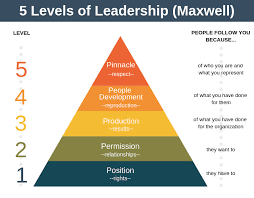
John C. Maxwell is an American author and a motivational speaker who wrote a book named “The Five levels of Leadership” in which he explains about the various types of leaders based on the impact they manifest on the people.


Positional Leadership


Different levels of Leadership


“The only real training for leadership is Leadership.”-Anthony Jay


 Leaders with a position have a very narrow influence on the people they lead. They have an impact on a very small scale over the lives of people. Their leadership is confined just to their position or authority over people.


Most of the leaders in the contemporary world exercise positional type of leadership. They may be captain or head of their football team, their university, their business organization or even their home. Leaders in this leadership position must recognize the limitations of their position or authority. Because of the same reason that they do not necessarily have a huge impact on their organization and individuals.


Different levels of Leadership


However, whenever a person is given a position, they have the opportunity to grow themselves a leader and reach to higher levels of leadership. It’s important for leaders to continually dedicate themselves to develop their leadership skills in order to become a better leader.


Service Leadership


Different levels of Leadership


“Leadership is not an affair of the head. Leadership is an affair of the heart.”-James Kouzes & Barry Posner


The next level of leadership after positional leadership is leadership by providing help or service to others. People may have to obey you without their will, when you are a positional leader for many things like their pay or to keep their job and therefore, they ‘have to ‘ follow you although they may not “want to’.


But leaders who focus more on understanding the needs of the people and making healthy relationships with them fall under this category. As a result of which, people willingly do what the leader needs to get done and always try to contribute their best to the organization. People prefer to work with such kind of leaders who understand them and help them rather than leaders who get things done merely by giving orders.


This level of leadership focuses primarily on the value of each person. All great leaders  value people. They know that every individual is unique and has some unique qualities which they can contribute to the organization. Therefore, they treat people with care keeping in mind with their importance. Everybody in this world wants to be treated with respect and care whether they accept this or not. And Great leaders understand this very basic and natural human psychology and consequently, they form good relationships with people.


Leaders need to understand the importance of serving, otherwise if they are too hard on people to achieve something, there are some people in their organization only who wants to see them fail.


Exemplary Leadership


Different levels of Leadership


“Authority: The skill of getting people to willingly do your will, because of your personal influence.”-James C. Hunter


Leaders who get the most out of people are usually the ones who lead by example. Great leaders are themselves committed to their work. You can give all the motivational speeches you want, but if you yourself don’t show a good work ethic and don’t apply what you say, there’s no way that people will do the things you say. It’s important for a leader not just to brag things on people don’t do the things that they want their people in the company to do and make a bad example.


This level of leadership is commonly found in military leaders but rarely found in business leaders. That is the reason behind an organization’s failure. The job of a leaders is to lead and you cannot lead from behind. To lead, you must set the right kind of example that you want your people to follow. Leading by example not only brings productivity but also creates a clear vision for the organization. It sets a standard for the people to follow. You cannot just keep people intact with principles and ethics until you follow them yourself.


You do not lead with your words. You lead with your actions and your life. The kind of life you live sets the standard for the people to follow and maintain. Therefore, it is the responsibility of the leader to make sure that they live by the standards that they wish to inculcate in their followers.


Developmental Leadership

Different levels of Leadership


“Your rewards in life will be in direct proportion to the value of your service to others.”- Brian Tracy


Effective leaders understand the importance of always developing. They understand that if they want to keep getting better at what they do, they need to commit themselves and their team to a learning attitude. And therefore, Great leaders are life-long learners and never stop learning till the time they die.


Steve Jobs was once shown a prototype of the iPad and looking at it, he complained that it was too big. When the engineers told him they couldn’t make it any smaller, Jobs took it over to an aquarium and dropped it into the water. ‘These are air bubbles’, he said. ‘That means there’s space in there. Make it smaller.’


This reminds us of the opportunity that we have at our work. Even though we do great work as a leader, there is always an opportunity for improvement. Great leaders never stop learning! They do not only commit to develop themselves but also others to become a better version of themselves. They are People Developers. And this is how they influence people with such immense intensity because of the connection they develop with others and inspire them to achieve great things. They know that when individuals develop themselves, they develop the organization automatically without any effort. And that is why, they work more on people rather than on organizations.


It not only provides a chance to fulfill others goals and desires but also gives a sense of satisfaction or fulfillment when they develop others. It takes a mature leader to see their progress in their followers success.


Natural Leadership
 

Different levels of Leadership


“A True natural servant automatically responds to any problem by listening first.”- Robert Greenleaf


 This level of leadership is the highest level of leadership. When a leader reaches this position of leadership, people follow them without thinking of their personal interests because they are influenced by the passion and inspiration of the leader. Leaders at this level do not demand ‘RESPECT’ from the people instead they receive it without even asking for it.


Leaders at this level have so much inculcated the qualities of good leadership that it becomes a part of their DNA. Whenever we talk about a long-lasting organization, we are not just discussing about the leaders that served but also the legacy that they left. Great leaders leave an impact on the people that people are not able to forget then even after they die. Great leaders live even after their death because of the influence they had on people.


Leaders at this level are so much matured in exercising their leadership over a long period of time that they do not even have to think about what to do in a particular leadership dilemma. They know how to handle the situation because of their prior experience. Leaders at this level are shaped by the tough and turbulent times that they face in their life or leadership position.


As a leader, it is your responsibility to determine at which level you are and how you can improve yourself to reach at the top. Remain humble and guide your way to the character based leadership.


REFERENCES:


1.      John C. Maxwell, The five different levels of leadership, pub. 2011

2.      Anthony Jay, 100 greatest leadership principles of all times, pg-05, pub.2007

3.      James Kouzes & Barry Posner, The Leadership Challenge, pg-06, pub.2012

4.      James C. Hunter, The Servant, pg-50, pub.1998

5.      Brian Tracy, 100 Absolutely Unbreakable laws of Business Success, pg-48, pub.2000


Is your WHY intact?

GAGAN


IS YOUR WHY INTACT?


Is your WHY intact?
Is your WHY intact?


Most successful people have one thing in common. They may have different backgrounds, races, cultures, opportunities to perform, or wealth. But the one thing that separates them from the crowd is that they know their purpose. They do not wander around in life, going from one job to another, changing their purpose and goals. Even though they might not be steady for sometimes in their life in terms of their finances and relationships. But they eventually make it to the end. What is the difference?


The only major difference is that they know what they want from their life and focus their whole energy solely on that goal. They know why they are on this planet and what they have to contribute to the world. They do not focus more on getting a job just to make a living. They know that they are here to make a difference.


The most important question is whether your WHY is intact or not? Is your WHY stable or fragile when problems strike? Is your WHY determined by you or by other people’s opinion around you?


This is a very important question to ponder over. It’s a question which needs to be asked to yourself each day, week, month and year passes on. Because if the problems is if you lose sight of your goals and your vision, you don’t even realize that you are out of track. Due to enormous technological advancements, there has been an increase in our social networks, resources, and most importantly access to the information. But it needs to be regulated according to your goals. And sometimes we don’t even realize before you get too far from your purpose.


Is your WHY intact?
Is your WHY intact?


When you now why you are doing what you doing, you need to keep yourself aligned to your vision. This is the difference between Great leaders and Managers. Managers do things which are urgent to sustain the organization but leaders prioritize important things over urgent things and thrive their organization because they know that not every urgent thing is aligned with their WHY.


Sticking to your WHY means going by your Plans. Most people make plans in not time but do not even bother to execute them. And without execution, your WHY is just a dream which won’t become a reality. Planning is the greatest proof that you believe in your WHY. You only Plan when there is something certain to happen. Even though your plans may change but your purpose or WHY must remain the same. Planning is just a route to get to your destination. So when you face trials of many kinds along your way, it’s not to stop you but to prepare you for your destination.


Is your WHY intact?
Is your WHY intact?


They come just to check whether you are capable or prepared to get to the destination or is it just a casual WHY? So if plan A fails in your journey, then remember there are 25 letters more. But your WHY should be firm in your mind. Is your WHY intact?

Seasons Of Change

GAGAN


SEASONS OF CHANGE


seasons of change
seasons of change


Everything in life is seasonal. No matter where you live, seasons come and go. It’s not just about the summer, winter, autumn or spring that I’m talking about. It’s more about the seasons of life. If you are facing tough & turbulent times, it is seasonal. When nothing seems to work for you, it is seasonal. When life hits us on our blind side and when we lose track of our destiny, it is seasonal. Everything in life is seasonal. And it’s your choice if you desire to allow a temporary problem to mess with your mind and impact you in a permanent way. It’s your perception about a problem that really matters the most.


It is your choice of staying calm in adversity that decides your response to that problem. We never complain about the fruitful good times, then why do we tend to mesmerize & complain in hardships?


We call it season of crisis. Everybody goes through a crisis at some point of their life. So how to survive through that crisis when everything seems to be falling apart and nothing seems to work? The key to surviving in a season of crisis is to outlast the season. So, when winter comes, you don’t lose hope thinking that it’s going to last forever. Do you? No you don’t (hopefully). You know that it’s going to be temporary and summer is on the way.


seasons of change
seasons of change


Life is akin to seasons. Even the worst things in your life are temporary. The key to thriving is outlasting that moment. You know that “this too shall pass”. So when a season of crisis comes, all you gotta do is outlast that season and it passes away. This is the thing that I appreciate about seasons. They are always temporary.


Even if you are in the season of prosperity rather than adversity, you need to prepare & plan for the season of adversity because seasons have no respect for your personal ambitions or goals. They just come without anyone’s approval.


So keep the weapon of planning in your arsenal. Because you never know when the seasons of life change. But if you are prepared to face them, life becomes easy. No person in the world is immune to crisis. They cannot stop it or even control it. But they can always manage it through planning and preparation. If you don’t plan, you simply become a victim of the seasonal change. The choice is all yours: either be a victim of change or become an agent of change.

Break the Rules!

GAGAN


BREAK THE RULES!


Break the Rules!
Break the Rules!


The greatest leaders in the world do not have much in common. They differ in their positions, wealth, races, resources and ages. They have different styles of leading and all of them focus on different goals. But despite the differences, they do share one thing: Before they do anything to achieve greatness in their respective fields, they first break all the conventional rules of wisdom Rules that bind most f the people in chains of mental slavery that prevents them from achieving their goals and vision. They know, if you wanna make new rules you gotta break some rules(old).

Rules are different from principles. Principles are inherent which are proven & guaranteed ways towards achieving a desired result. But rules are temporary. Every successful person on this planet broke the conventional rules to reach to the position where they are now. Contrary to principles, which maximize your growth and provides the way to your destiny, rules act as a barrier in your journey to fulfilling your goals.

There are some predictable consequences depending upon whether you choose to submit to rules or decide to break them. Your obedience to the rules determines your level of success. As I said, rules are not principles. Rules are produced and incubated by the society. When you try to do something great, people around you who are regularly washed with the rules say, “Do not try this. Nobody has ever done that before. How will you do it?” When you think of influencing & impacting the world, rule says “You are not from the right family background with no resources. How will you do it?”


Break the Rules!
Break the Rules!


Rules sometimes becomes your biggest obstacles in your path of getting to your purpose. But it is those people who break and overcome these societal beliefs (which they sometimes call ‘norm’) and rules who make it to the top.

Any human who has done something significant in their life and impacted the world, never gave in to the rules created by others (which is generally their own measure of their potential).

Warren Buffett better known as the “Oracle of Omaha” said in once of his interviews that a major reason for his success in investments is that he does not go by the rules of the market. Every other investor follows the rule of investing when the market is flooded with investments. He went on to break this rule which inhabited even the minds of Big Investors.

In his book Good to Great: Why some companies Make the Leap… and others Don’t, author Jim Collins says that great leaders have the discipline to confront the most brutal facts about the current situation. They cut through the hype and spin to uncover the truth. They ask tough questions, face challenges squarely, and analyze both hard and soft data. In other words, they challenge the conventional rules and create their own rules.


Break the Rules!
Break the Rules!


Many people follow the rules because it sometimes encourage to label themselves as ‘leaders’. And this is the main difference between a manager and a leader. Managers mostly look on the outside environment to change their own life rather than focusing on themselves and how their presence can impact others.

A person who depends on the rules will generally wait for the right opportunities but leaders create opportunities for themselves. If you really want to make a difference in the world, you need to become a rule—breaker! The choice is all yours: either live an ordinary life as a rule-follower or make a difference by breaking rules!


Real leaders don't boss

GAGAN


REAL LEADERS DON’T BOSS


Real leaders don't boss


Real Leadership does not necessarily come from attending seminars, webinars (more popular these days) or strictly from guidebooks. Real Leadership comes from within. Ordinary people become world-changing leaders when they discover themselves. That’s why I believe that true leadership is self-discovery. And that brings us to another aspect of true leadership which is to inspire and motivate people to achieve higher standards in their lives.


Real leaders never try to manipulate or control others. That is the difference between a leader and a boss. Leaders don’t boss. People who have this temptation to control others usually lack a sense of security in themselves. So when others try to reach at their level, they feel the insecurity of losing their position or entitlement and prevent them from progressing in many different ways. But they forget that in the process of doing so, they themselves are not moving anywhere. They are stuck at the same level where they try to prevent others from leveling up.


And real leaders knows the importance of inspiring and helping others to succeed. They neither try to stop people from advancing nor step down to reach people. They bring people to the level where they are and make the best out of them. Real leaders have a sense of obligation and commitment to help others succeed. The most joyous moment of their life is when they help people improve everyday even if that improvement is minute.


REAL LEADERS COMMUNICATE:

Real leaders don't boss


The ability to communicate effectively is one of the most crucial characteristic of a real leader. Due to technological advancement, person to person communication has been readily diminishing. A new concept in some of the world’s leading businesses and organizations.


It’s your responsibility as a leader to make a connection with your audience & competitors and the outcomes will be more consistent & predictable. So, make a commitment to communicate even when the stakes are high because unless you communicate you cannot understand their problems, thoughts and ideas to make yourself more effective.


REAL LEADERS LISTEN:


Listening to your people is a very important skill which you must prioritize if you really want to earn their respect. Most leaders really don’t have the appetite to listen, they just want to speak. They just want to be heard. Nobody wants to listen. Right? But unless you listen, you won’t learn new things. When you speak, you still know what you already knew. Your knowledge is still the same. But when you listen, your mind expands to other new things and you get to know from different perspectives which you might have never known if you would have just focused on speaking.


Apart from learning new things, there is another thing which can be considered a reason to listen. When you listen, the other person feels a sense of significance & approval. When you simply nod your head while listening or agree by making specific gestures, they feel important and approved. And when it’s your turn to speak, they are all ears towards your point of view.


REAL LEADERS KNOW CHARACTER COUNTS:


Real leaders don't boss


Leaders are commitment to their moral standards & ethics that they never violate. Leaders of character are highly trusted by the people they lead because of their Integrity and loyalty. There should be some intact principles and standards in place to guide your leadership journey and become more effective in taking the best out of people.

What are your thoughts about it? Do share below!